
Weeks 1–2
Pain
Take the edge off first.
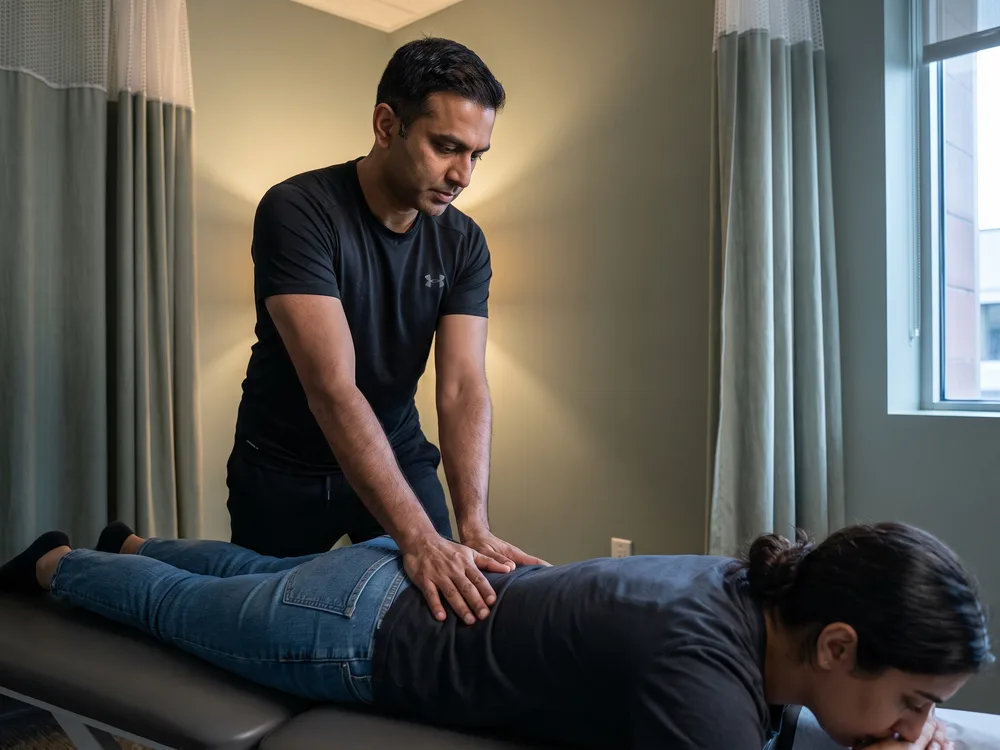
Hands-on work on the irritated segment and the tissue the nerve runs through calms your back and that leg down, starting on your first visit.
What We Treat
Bend down for the laundry basket without doing the math first. Right now it’s the ache that wakes you before the alarm, and the burning line down one leg by the time you’ve parked at work. Both are fixable, and it starts with a cause-first evaluation, not a guess.
Sound Familiar?
Two or more? Keep reading.
Why It Happens
Your back doesn’t hurt at random, and it’s almost never one thing. Usually it’s a mix: a disc that got irritated and started crowding a nerve root, which is what sends that line of pain down your leg. Spinal joints that stiffened up and stopped sharing the load. Deep core muscles that quietly gave back strength after your last flare-up. And hips and glutes that lost their flexibility, so the mechanics of your spine change every time you bend, lift, or sit down.
None of that shows up in a two-minute glance. It takes a cause-first evaluation to sort out which one is actually driving your pain, and whether the leg symptoms come from the disc or from the tissue the nerve travels through on its way down. That’s why rest, ice, or a printed stretching sheet keeps falling short: they answer the symptom and never ask the question. You’ve been the one who lifts what needs lifting, at home and at work, which is exactly why nobody has looked at your back yet, and exactly why you’re reading this. Find the cause and the fix stops being a guess.
The Honest Truth
Nobody regrets starting too early. Every week, someone here says they regret waiting.
How We Fix It
Every plan has an endpoint. Here’s what the four phases look like for back pain and sciatica.
Weeks 1–2
Pain
Hands-on work on the irritated segment and the tissue the nerve runs through calms your back and that leg down, starting on your first visit.
Weeks 2–4
Prime
Targeted mobility work frees the stiff segments and the tight hips that have been making your low back do their share of the bending.
Weeks 4–6
Perform
Progressive core, glute and hip strengthening puts real support back under your spine so the nerve stops getting crowded in the first place.
Weeks 6+
Prevent
How you lift, twist and sit gets tested under real load, and when it holds, you’re done: that’s the endpoint, not another appointment.
EHS is amazing, how they all work together to help patients come first and get back to where they should be after surgery. Chris thank you for taking everything on FB and making sure I was scheduled on the Monday after surgery
Shared by Heidi P. · EHS patient
Questions, Answered
Usually not, and it’s rarely the first step. Most back pain and sciatica improve without imaging, and scans routinely show disc bulges and wear and tear in people who have no pain at all, so a picture doesn’t always name the cause. We start with a cause-first evaluation to find what’s actually driving the pain in your back and down your leg. If imaging turns out to be genuinely necessary, we’ll help you get it, but you don’t have to wait on a scan to start feeling better.
Usually the opposite. Hurt and harm are not the same thing, and total rest tends to leave a back stiffer and weaker, which is what sets up the next flare-up. What matters is dose and direction: which movements settle your nerve down, and which ones wind it up. You work that out one-on-one with a licensed physical therapist or chiropractor, every visit, and you progress when your body has earned it, not on a printout’s schedule.
On average, our patients see a significant drop in pain in six visits or less. A full plan for back pain and sciatica is typically 2 to 3 times a week for 4 to 6 weeks, moving through Pain, Prime, Perform and Prevent, and how long you’ve been dealing with it moves that number. Either way you get a plan with an endpoint: you’ll always know which phase you’re in and what’s left, not an open-ended string of appointments.
Book Your Visit
Request a time and a real person calls you back with the soonest opening. No phone tree. No ‘someone will reach out.’ Just a plan.
5.0 · 312+ five-star reviews
A real person calls you back, not an auto-reply
Step 1 of 5
That’s the hard part done. We’ll call during business hours to lock in your time.
Visit Us
One clinic, in Midtown Omaha at 1016 S 74th Plaza. We treat patients from Midtown, Dundee, West Omaha and Millard.