
1
Drew tests to find which joint stopped moving.
Get the stuck joint moving again, then keep it that way. The adjustment and the strength work that holds it happen in the same building, coordinated.
What It Is
An adjustment is a quick, controlled push into a joint that has stopped moving through its full range. Dr. Drew Callaghan, DC, finds the segment that is stuck, positions you so nothing else takes the force, and gives it one short thrust. Sometimes you hear a pop. That sound is pressure changing inside the joint, not a bone going back into place.
For a while afterward that joint moves further and the muscles guarding it stop working overtime. That window is the whole point, because it is when loading the area actually goes well. Here the loading happens in the same building, in the same plan, so the joint gets mobilized and then gets the strength work that makes the change stay.
What it is not: a standing appointment for the rest of your life, and not a treatment for problems outside your muscles and joints. We adjust joints to change how they move, and we tell you plainly what that does and does not fix. Drew came to chiropractic as a kid, to deal with migraines that hit every week, and kept using it through a college basketball career. He will tell you the same thing we do: the adjustment opens the door, the training walks you through it.
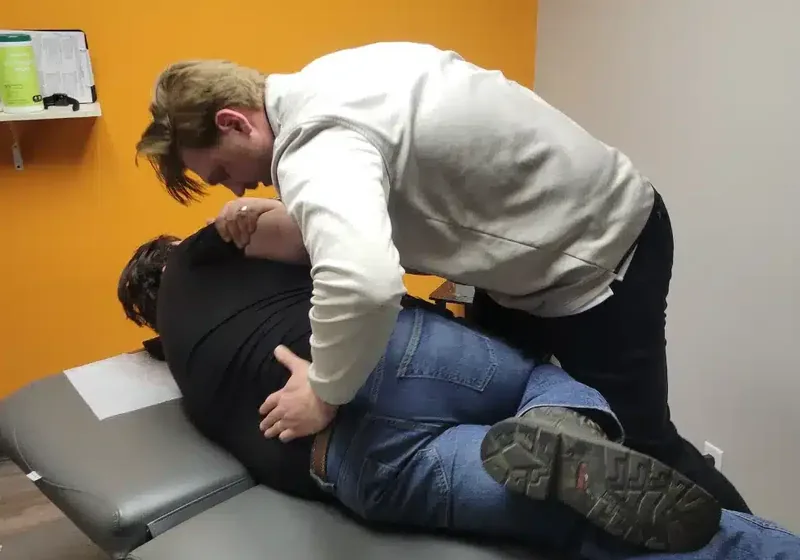 Same building as your PT plan
What It Helps
You have been quietly working around this for months, telling yourself it loosens up by mid-morning. It does, right up until the morning it does not. And by then the muscles guarding that joint have been on overtime long enough to start hurting on their own.
What A Session Looks Like
1
Drew tests to find which joint stopped moving.
2
He shows you the adjustment, then you say go.
3
You load the new range so it holds.
Why It Works
The joint moves again, not just around it.
Guarded muscles finally stand down.
The strength work is down the same hallway.
A plan with an endpoint, not a punch card.
Questions, Answered
Most people feel pressure, then relief. The thrust itself is quick and small, and the pop you may hear is pressure changing inside the joint, not bone moving out of place. Drew tells you exactly what he is about to do and where, every time, and nothing happens until you say go. If you would rather skip the thrust entirely, there are gentler ways to get the same joint moving, and we will use one.
For muscle and joint problems, yes, and it is not right for everyone. Some conditions rule the thrust out, including osteoporosis, tumors and spinal cord compression. That is why the visit starts with an evaluation and your history instead of a table. If your case is not one for an adjustment, Drew says so out loud, and because physical therapy and chiropractic sit under one roof here, the alternative is one door away.
You get a number at the first visit, not an open-ended standing appointment. Most plans here run 2 to 3 times a week for 4 to 6 weeks, and on average, our patients see a significant drop in pain in six visits or less. Want to talk it through before you book? Call us at (402) 939-8026.
Book Your Visit
Request a time and a real person calls you back with the soonest opening. No phone tree. No ‘someone will reach out.’ Just a plan.
5.0 · 312+ five-star reviews
A real person calls you back, not an auto-reply
Step 1 of 5
That’s the hard part done. We’ll call during business hours to lock in your time.
Visit Us
One clinic, in Midtown Omaha at 1016 S 74th Plaza. We treat patients from Midtown, Dundee, West Omaha and Millard.