
1
We test the segment, not just the sore spot.
For the segment in your neck or low back that quit moving: one quick, targeted thrust, and most people feel the area move more freely before they leave the room.
What It Is
Your spine is a stack of joints that are supposed to share the work. When one segment stiffens up, the muscles around it splint to protect it and the segments above and below start covering its share. You feel that as a low back that locks, or a neck that turns one way and not the other.
Spinal manipulation goes after that one segment. You get positioned so the joint is taken right to the end of its slack, then a fast, small thrust goes through it. Clinicians call it a high velocity, low amplitude thrust, which just means quick and shallow. The pop you hear is pressure changing inside the joint, not bone grinding on bone. Dr. Drew Callaghan, DC, performs the adjustment here, and the plan around it runs one-on-one with a licensed physical therapist or chiropractor, every visit.
It is not a bone being put back in place, and it is not a standing appointment you keep for the rest of your life. It is also not the slow joint mobilization your therapist may use on the same segment: same target, different speed. And you do not shop for it. It goes into your plan when your evaluation says it will move the needle, and it comes out when the joint holds its own.
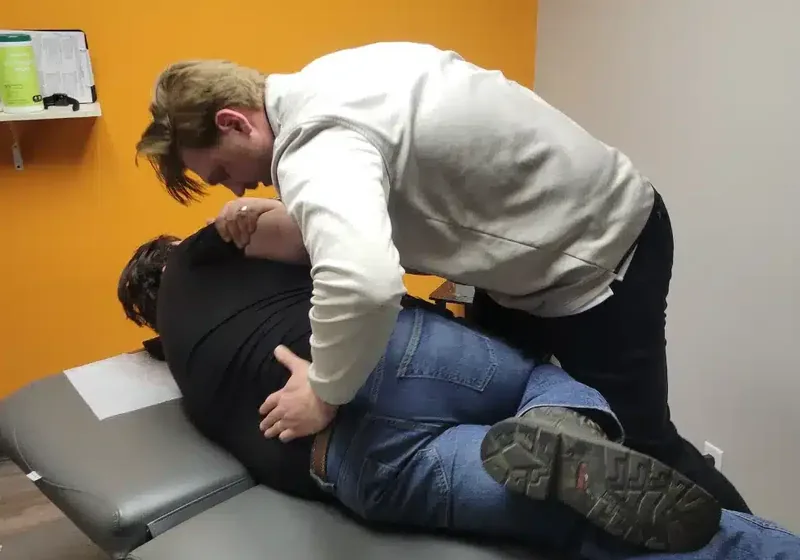 Used when your evaluation calls for it
What It Helps
You are the one who handles things before they get expensive: the brakes, the furnace, the gutters. Your back keeps sliding down that list, and a segment that stays locked another six months is a segment your hip and knee end up paying for.
What A Session Looks Like
1
We test the segment, not just the sore spot.
2
You get positioned, told what is coming, then one quick thrust.
3
You move it and load it before you leave.
Why It Works
More motion, usually in the same visit.
Muscles quit splinting, so exercise works.
The stiff segment carries its share again.
A tool in a plan, not a standing appointment.
Pairs Well With
Questions, Answered
Most people describe pressure, a quick release, then relief. The pop is a pressure change inside the joint, not bone grinding on bone. You get positioned first, you hear exactly what is coming, and nothing happens until you say go. A day of soreness afterward is common, the kind you get from a hard workout. If you would rather start slower, say so: there are gentler ways to get the same joint moving.
Dr. Drew Callaghan, DC, screens you before he adjusts anything, and that screen exists to find the reasons a person should not be manipulated. If you are one of them, we say so and treat the problem another way. Tell us about your medications, any imaging you have had and anything else you are being treated for, so nobody is working from half the picture.
Nobody can answer that honestly before examining you. Manipulation is not the plan, it is one tool inside a plan, and it shows up only on the visits where it will move the needle. Plans here typically run 2 to 3 times a week for 4 to 6 weeks, and you will know at each visit whether the joint is holding its motion on its own. Call us at (402) 939-8026 and we will tell you what we actually see.
Book Your Visit
Request a time and a real person calls you back with the soonest opening. No phone tree. No ‘someone will reach out.’ Just a plan.
5.0 · 312+ five-star reviews
A real person calls you back, not an auto-reply
Step 1 of 5
That’s the hard part done. We’ll call during business hours to lock in your time.
Visit Us
One clinic, in Midtown Omaha at 1016 S 74th Plaza. We treat patients from Midtown, Dundee, West Omaha and Millard.